An Introduction to Libraries and Joint Occupational Health and Safety Committees - the basics

As always, a reminder that we are trained but not professionally certified in OH&S and are writing this from the perspective of workers. We want more people to be aware of the regulations and systems that influence their working conditions in order to become informed and to use the tools that exist to improve their working conditions. We share our experiences only as examples and opinions, not as legal advice. We hope you learn something and are curious enough to read up on the regulations in your own province.
It’s also important to know that, although all Canadian provinces and territories operate under the same federally legislated labour acts, how they are enforced and what the requirements are differ depending on how your local provincial or territorial government dictates. If your provincial government does not invest in enforcement or have meaningful timelines for enforcing improvements, OH&S regulations may play out weaker than other provinces with better commitments to worker health and safety. Don’t forget that when industry lobbies your government for weaker enforcement, that impacts the safety of your workplace.
As well, regulations and policies change all the time and we do not promise our information is always up to date.
1. OH&S Committees - the basics
Public Libraries of a certain size are required to have a health and safety committee made up of employer and worker representatives. Some larger library systems may also have smaller committees when a location is situated within another facility. These committees are the foundation of all safety-related work and its processes lend themselves well to public library settings. Library workers, generally speaking, prefer order, processes and consistency. Occupational Health and Safety provides this in abundance, along with many forms to fill out.
The duties and responsibilities of the Committee are laid out by the legislation, regulation and guidelines of the governing body which oversee workplace health and safety. Because this varies amongst provinces, we won’t be going into any specifics. This article is the first in our OH&S and Libraries series and over time we will focus on how frontline workers can utilize OH&S to reduce the likelihood of violence in the workplace and other hazards which present in changing public library environments.
At a Glance: Provincial OHS committees and requirements
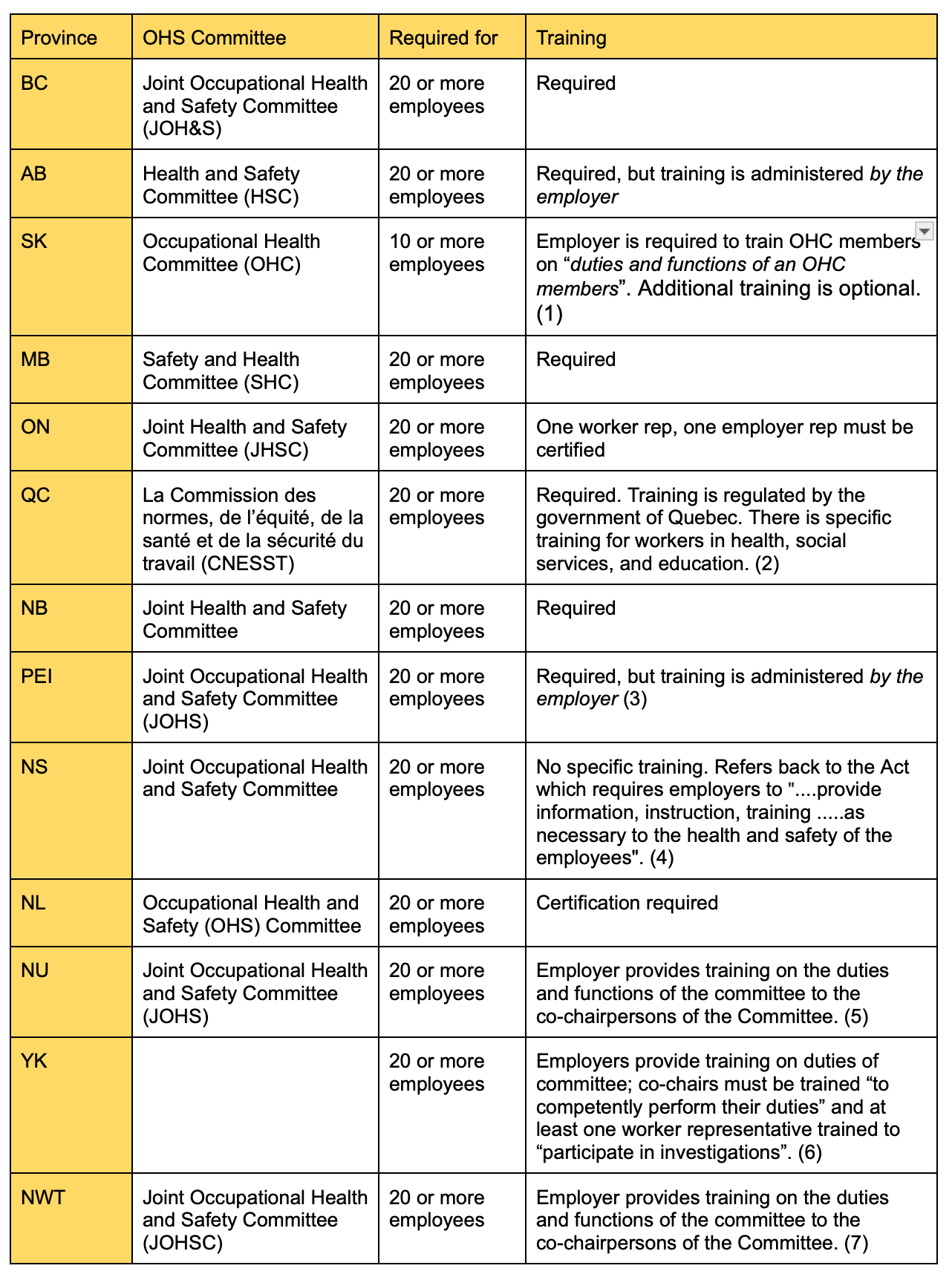
- https://www.saskatchewan.ca/business/safety-in-the-workplace/ohc-and-ohs-representative/ohc
- https://www.cnesst.gouv.qc.ca/fr/prevention-securite/organiser-prevention/mesures-specifiques-etablissements/appliquer-mecanismes-prevention-participation/mecanismes-participation/mettre-en-place-comite-sante-securite/comite-sante-securite
- https://www.wcb.pe.ca/DocumentManagement/Document/pub_guidetoworkplacehealthandsafetycommittees.pdf
- https://novascotia.ca/lae/healthandsafety/jointhealthsafetycommittee.asp
- https://www.nunavutlegislation.ca/en/consolidated-law/occupational-health-and-safety-regulations-official-consolidation
- https://www.wcb.yk.ca/web-0044/health-and-safety-committees
- https://wscc.nt.ca/sites/default/files/documents/Joint%20OHS%20Committee%20Code%20of%20Practice%20NT%20and%20NU%20English.pdf
An OH&S Committee typically meets monthly and its core purpose is to have oversight over the preventative actions around workplace injuries, identified risks, persistent causes of injuries, and to regularly review committee function. Committees are a place where creativity and urgency can wither but can also be a place where workers participate in the theatre of equality and objectivity, and gain access to training.
Like any work of mutual aid or solidarity, an OH&S Committee is only as effective as a worker’s level of engagement. Coming into this work with the assumption that the work is already doomed, or that someone else will care as much about your safety as you do, will make it very challenging for you to sustain long term active participation.
To figure out if your OH&S Committee is functional or dysfunctional, here are a set of questions to consider:
- Do workers know about the health and safety committee? Can workers name any member who sits on it?
- If a worker was injured at work, would they know who to tell and how to report it?
- Does the unionized side regularly meet before an OH&S meeting and to gather OH&S concerns that come from the general membership?
- Does the role of Union Co-Chair regularly change? Is the work falling into complacency because the same people have been in the role for too long?
- Are general safety concerns regularly brought up and discussed, or do most workers manage risk on their own?
- Is discussion at the OH&S meetings (or at worksites?) productive, engaged, and open to all members (full and alternate)?
- Are there broad statements made that directly contradict factual reality or workplace safety legislation?
- Does the OH&S committee regularly review the rate of escalated incidents that involve workers? When there is an ongoing safety concern at a workplace, is progress made to correct the issue or is it a source of frustration and resignation for workers?
Next in the series, we run a workplace injury scenario through the clanking machinery of OH&S.